

It goes without saying that Easter is a joyous day for church people. On Easter morning the music is marvelous and the room is full. Toddlers are dressed in special Easter outfits that are super cute…as long as you don’t know was required to get them on. Brunch plans and egg hunts are at the ready and so is the candy. We live in a divisive world these days: there are only two kinds of people: people who like peeps and people who don’t—but on Easter morning we all try to get along.
Not everything about Easter is ideal—sometimes it’s rainy; I have a pastor friend who used to say that when she died and went to heaven her first question was going to be why Jesus lets it rain on Easter. Sometimes it’s cold. At a church I served in Chicago we had a sunrise service on the shores of Lake Michigan; and some Easter Sundays we’d go out there and there would be snow on the ground and wind strong enough to put sand in your face, and it would be cold enough I could barely hold onto my sermon. But there were people for whom this was their tradition, and they would show up without fail to welcome to good news of Resurrection.
Easter has a way of happening not only in the best of times but in hard circumstances too.
What really amazes me about Easter is that it happens not just in inconvenient places but in the truly tragic and horrible ones, even there, Easter still comes. Easter will still be preached today in the storefront churches and corrugated iron chapels where the worshippers are desperately poor. Easter will come today for people with dementia and Alzheimers who might remember the hymns even if they no longer recognize their families. Easter will be preached in Bethlehem and Beirut. Easter will be preached among immigrants and refugees who have been displaced for months or years in Sudan, in Haiti, and along our southern border. Of course, in desperate places, the message is not quite the same as it is here; it is about a stubborn kind of Resurrection hope that prays in desperation for justice to be done, for the comfortable people of the world to notice, and for a time when change will come.
We live in a big wide world, with so much that draws out our compassion and longing for change. And I am grateful that in the midst of the joy in this room today, that I preach Easter in a place where we remember the struggles and experience of others, and hope not to take for granted the blessings we enjoy. Easter is beautiful and revolutionary in our world precisely because it is for all of God’s children.
Today in this congregation, we will ask two questions we’ve been asking about God and Jesus throughout the winter and spring: What does Resurrection tell us about God, and what does it tell us about how to be human? Let’s start with just a little of what we mean when we say “resurrection.”
Jesus came from a tradition that didn’t spend a lot of time on Resurrection and for that matter, the afterlife. The religion of the early Hebrew and Jewish peoples seems to emphasize a way of living in the world, without much thought given to what happens on the other side. Of course some thought about it. Many of you may know the story of the Prophet Ezekiel; God leads him into a valley of dry bones, a desert graveyard, where God shows him that the power of the Holy Spirit can connect the footbone to the kneebone, the kneebone to the thighbone, and breathe life into places where there was death when we “hear the word of the Lord.” Other Old Testament prophets, Daniel and Isaiah among them, speak of eternal life as a place where the wrongs of this world are put right, where the comfortable and oblivious people of the world receive no further comfort, but where those who suffered and struggled through life find their just reward. This kind of talk about resurrection does not challenge the idea that human beings shouldn’t die or stay dead, but it’s certainly a message about justice.
The New Testament has more to say about resurrection, but is still mostly mysterious on the subject. All four Gospel stories of Jesus agree that the Tomb was empty, but none of them try to describe how that happened. The Resurrection appearances Jesus makes to his disciples seem to leave them inspired and awed, yes, but first confused and afraid, and they surely have no explanation. So when we gather on Easter morning with other Christians, it’s probably just fine if we have some of you in the room who imagine an embodied, in the flesh Jesus, walking around in skin and bone like you and me, while others understand this day more as a metaphor—a story whose power comes from those who keep telling it. Still others aren’t quite sure and find themselves someplace in between. There’s room for all of us; we’re richer because we’re together.
What the Bible stories do seem to agree upon is that in the promise of Resurrected life, somehow things that are broken get repaired, the hurts of the world receive healing. As the Apostle Paul says it, “Listen I will tell you a mystery! We will not all die, but we will all be changed, in a moment, the twinkling of an eye, at the last trumpet… What is sown is perishable, what is raised is imperishable. It is sown in dishonor, it is raised in glory. It is sown in weakness, it is raised in power.” And John in Revelation: “Look, the home of God is among [human beings]; God will dwell with them…God will wipe every tear from their eyes. Death with be no more, mourning and crying and pain will be no more, for the first things have passed away…”
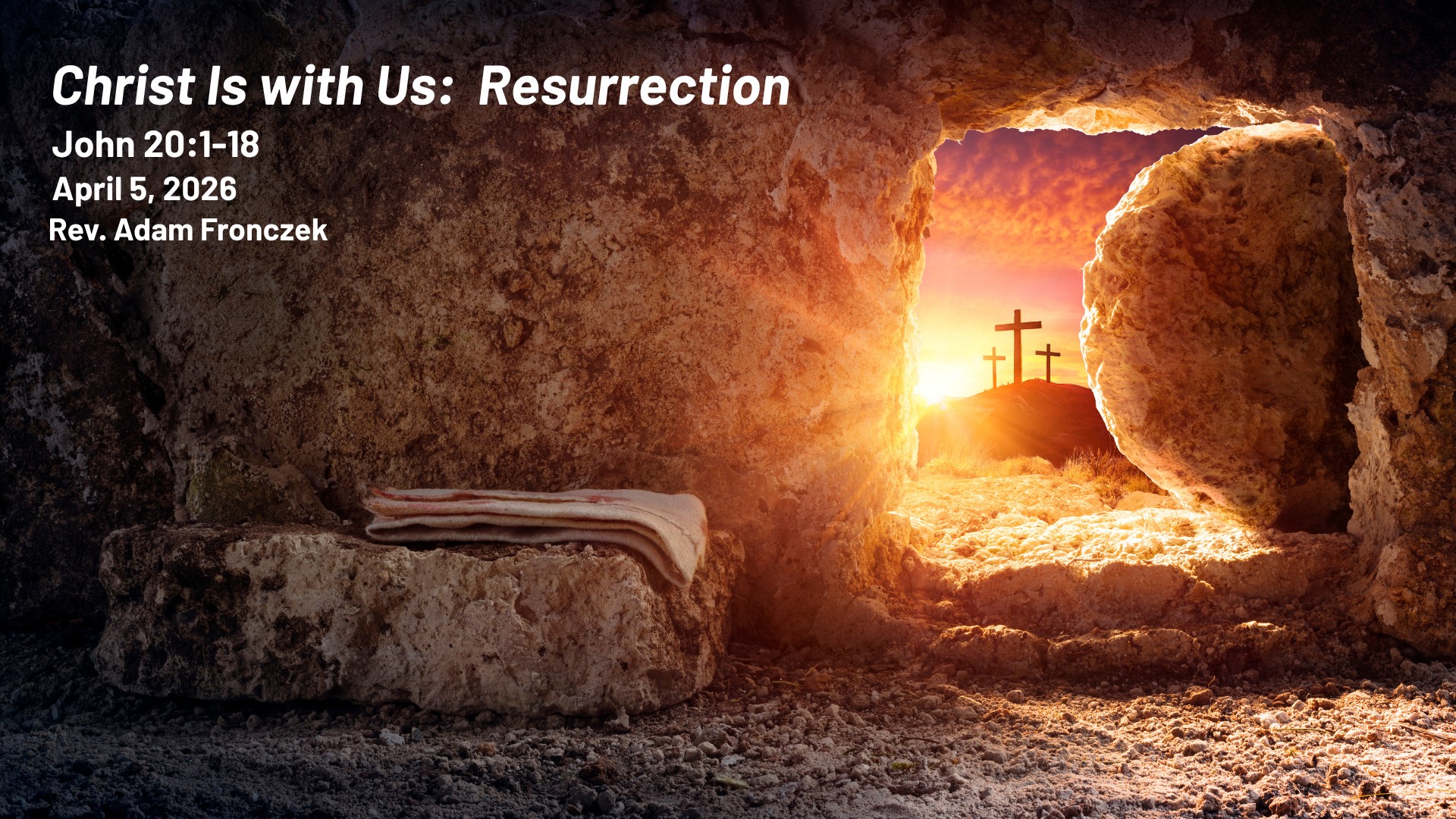
It all begins in the story of the Empty Tomb, which this morning we read in the telling that comes from the Gospel of John. John’s telling includes all the raw human emotion that comes with grief and loss and hoped for healing. Early in the morning, while it was still dark, Mary Magdalene comes to the Tomb and finds the stone rolled away. Mary did not go to the Tomb expecting Resurrection; she expects death, and is still reeling from the horrors of Jesus on the Cross; so when she sees the stone rolled away, she is deeply frightened and runs to find the comfort of her friends. When they return together, the disciples enter the Tomb and find the burial clothes, and in various stages of belief or disbelief, they return to their homes. Mary, still grieving, sits down at the entrance of the Tomb and begins to cry. It is at that moment that the angels make their presence known, inviting Mary to imagine that something other than death and grief is at hand. And then Jesus appears; he is somehow different enough that she mistakes him for the gardener, but he makes himself known to her when he calls her by her name.
The story’s power comes not just from some kind of magical discovery that Jesus never died, but from the reality that he was dead. The power of Resurrection comes from taking the Cross seriously. As is so often the case, only when we are acquainted with the sufferings and fragility of life do we appreciate life’s blessings for what they really are.
A regular part of my job, which I would admit is difficult, but also a blessing, is to be welcomed into the life of someone who is struggling–someone has been informed of some kind of life changing news: a terminal diagnosis; an accident that will change them forever; the loss of a loved one that will reshape their life. We never want these struggles for people, but life is full of them; and to be a pastor, a person who is invited into sacred spaces of hardship when things are at their worst is truly one of the great blessings of my life—and I learn from it all the time. Though we never wish tragic turns of events on anyone, sometimes they lead to wisdom the rest of us fail to find. People who are aware of the nearness of death, often come to know the preciousness of life. Only because we have followed Jesus to the Tomb, do we have a chance to be surprised by joy when it is empty. So Resurrection makes us hopeful in the face of our own struggles that God one day will redeem.
What Easter tells us about God is that even in the face of great suffering and even death, God remains with us. God is not a fair-weather fan of human life, joining in church only for the baptisms and on the wedding days, but in the moments and seasons of life when we experience the greatest despair. God is with us still, waiting as long as it takes for the door to crack open to healing, hope, and new life. And new life is the glorious promise of today; borne out of the awareness that the God we worship is willing to go with us even unto death. We celebrate the hope that death is defeated, that love wins, that Christ is Risen.
We don’t always celebrate the Lord’s Supper on Easter Sunday, but we will do so today. And as you come to the Table, I invite you to come full of joy—not just naïve happiness, but a joy that you draw from all your deepest wisdom and life experience. For this is a Table Jesus prepares for a world that put him to death. This Table is prepared out of the brokenness of his own human body and pouring out the compassion of his very own life, so that people in every human circumstance will know that God is with us—and that we are called to be with and for each other. The Bible tells us that this is the joyful feast of the kingdom of God, and that one day God will is to gather us from north and south, east and west, from every race and clan, every age, every nation, every time; the joyful as well as the struggling, to be redeemed by the love of Jesus Christ. At this Table, we learn what the Resurrection tells us about being human: that there is no us and them; there is only we. Easter is for all of God’s children. This is God’s great hope for all; and as you come to this Table this morning and take God’s love out into the world, may that Resurrection joy be at work in your life. All to God’s glory and honor and praise. Amen.