

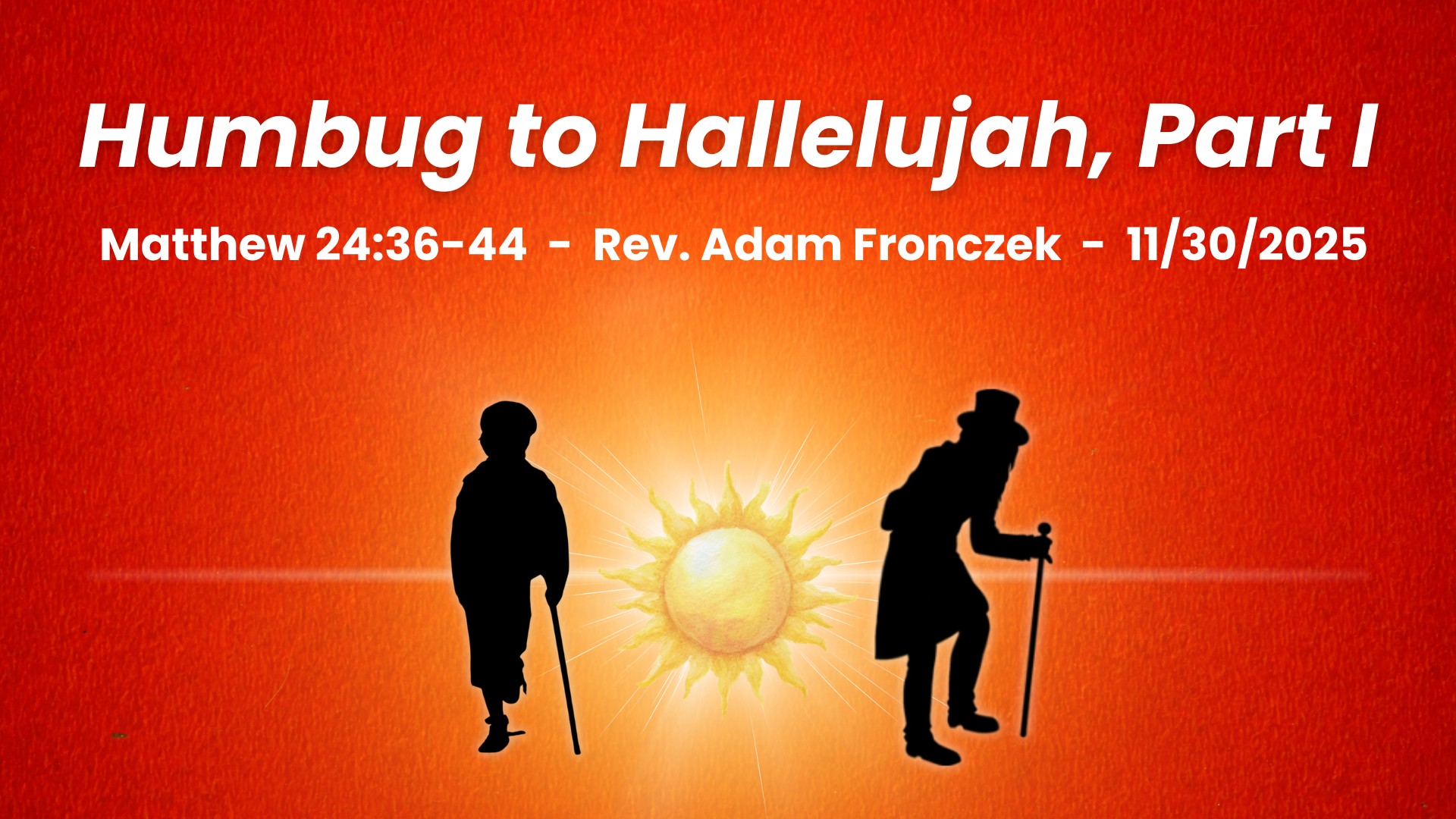
“Marley was dead…” Those are the opening words of the old Charles Dickens play A Christmas Carol, the story that has been told and retold until “Scrooge” has become synonymous with a miserly, joyless person, and if you want to sound like a grumpy, joyless downer at Christmas, everyone knows you use Scrooge’s phrase, say it with me, you say: “Bah Humbug.”
In case you need a little refresher on the story itself: Ebenezer Scrooge is an old businessman. It’s Christmas Eve, and on this day seven years before, Scrooge buried his business partner and closest friend Jacob Marley, hence the play begins, “Marley was dead.” In the opening scenes we meet Scrooge who is as grumpy, greedy and joyless as a person can be. Importantly, you meet him in his conversations with other people: his kind employee Bob Cratchitt, his joyful nephew Fred who tries to invite him to Christmas dinner; Christmas carolers and fundraisers visit Scrooge’s office collecting to help the poor; Scrooge throws them out the door.
It was interesting to me, revisiting the story, to notice that Scrooge, as nasty as he is, is a sympathetic character right away; watching the play, you feel sorry for him. In the exchanges he has with those other characters, it’s obvious that each of them is much happier than Scrooge himself; you immediately feel sorry for Scrooge; there is obviously something wrong in his life. That opening phrase “Marley was dead” signals right away that seven years later, Scrooge still hasn’t figured out what to do with his grief. Scrooge may have been just as grumpy and greedy even before Marley’s death—it’s hard to tell; but as he tosses aside every pleasant “Good morning” and “Merry Christmas” that crosses his path, insisting on being angry, you want to take him by the shoulders and say, “Wake up, man! You’re wasting your life!”
That is exactly what happens next. Scrooge goes home to his big old empty house, and that night he is visited by the ghost of his old partner Jacob Marley; Marley warns him that he only has one life to live and that he is wasting it. Scrooge resists this warning from Marley’s ghost; so he will be visited by three more ghosts, the Ghost of Christmas Past, the Ghost of Christmas Present, and the Ghost of Christmas Future. These ghosts will try to wake him up, to breathe some new life into this man who has lost his joy. Over the next three Sundays, we’ll visit with those three ghosts as we go on the journey of Advent together.
Why in the world would we do that, you might ask? Perhaps you’re thinking, “Adam, I can sit on my couch at home and watch A Christmas Carol. Can you not, with your fancy seminary education, come up with some Advent sermons based on, I don’t know…the Bible?” Well of course I can; but there’s actually a biblical reason we’re talking about Scrooge.
When you take a closer look at the play, it turns out that this play, which at first seems pretty secular, is about as churchy as it gets. Charles Dickens crafted the story to follow the selected Bible readings for Advent in the Church of England. He wrote the story to criticize the church and Christians who went through the motions of Advent but had forgotten the meaning of Christmas. For instance, at the time, England had a long history of what were called Poor Laws. On the face of it, these laws sought to support the poor by providing a social safety net for orphans, widows, debtors, and others who were most vulnerable; but in reality, the Poor Laws were a kind of indentured servitude, where people were punished for being poor. The church ran workhouses and schools where the poor were trapped in hopeless working situations that were impossible to escape. Dickens’ play criticizes this oppressive system and the joyless Scrooges that profited from it in the name of being Christian.
Even Scrooge’s name is biblical. An “ebenezer” is an Old Testament reference to 1 Samuel 7; there the prophet builds a monument, an “ebenezer” to remind him of the ways God has seen him through tough times. Spoiler alert: In A Christmas Carol, Scrooge will be redeemed from his joylessness, he’s going to rediscover the meaning of Christmas; and his very name reminds us that happens because God is at work in his life. So, yes, this story is very churchy, and very biblical.
So, let’s look at the reading, today’s first reading from the Gospel of Matthew, this strange text from chapter 24. It talks about people in the time of Noah and the flood, going about their business, eating and drinking and getting married and going through the motions of each day…until one day Noah walked into the Ark and the rains came, and everything changed. The passage continues that there are days when a women might be grinding meal or men working in the field and all of a sudden one will be swept away and the other left behind when all of a sudden life changes forever. These endtime visions sounds scary or crazy but they are not so different than thoughts that cross our minds every day. For instance:
I was talking earlier this week with a friend who lost his Dad earlier this year and would be headed to his Mom’s house for Thanksgiving. They had all been close, and this Thanksgiving would be different, and he said, “you gotta go and enjoy of all those moments you have with Mom, because any day life could change and she could be gone too.” We all can think of things that are like that: “What if my Mom isn’t here next Thanksgiving, or what if I am not?” “Before I know it, the kids will be old enough not to want to hold my hand anymore.” “Before I know it, they will be grown up and out of the house.” Before long, my life may be near its end, and I’ll have to look back and ask if I was as generous and as helpful and as joyful as I should have been…
And when those days arrive, some of us will look back with gratitude, knowing that we gave it the best and most joyful shot we could; we will be grateful to be surrounded by treasured memories of a life well lived, knowing that the world is a bit better because of what you did with the time you had, and grateful to pass it all on to the next generation.
And others will be haunted by what a Scrooge they have been, wasting the time they had. Some among us, it is sad to say, will look back on life and see how they have been overcome by resentments, resisted help for depression or addiction, or just spent way too much time accumulating wealth, climbing the ladder of power, having all the right stuff, and now it’s too late to live. This is what the reading for the first Sunday of Advent is talking about with its urgent plea to the women grinding meal and the men working in the field: it says: “Keep awake!” For you don’t know at what hour life will change. It’s just like when we watch the opening scene of A Christmas Carol and want to take Ebenezer by the shoulders and shake him, “Wake up, Scrooge! This is the one life you’ve got!”
These examples suggest that the world is full of people who are either full of joy or a total Scrooge; the reality of course, is more complicated, and so is the meaning of the play. The popularity of A Christmas Carol comes from the fact that all of us have a little Scrooge inside of us. For some of us that means we’ve been hoarding our money as if we’re taking it with us to heaven, or as if money is a source of real joy. For others we might be grieving, as Scrooge is, the loss of a friend, or the loss of a spouse, or a broken relationship, or frustration over something in our life or the world around us that has us deeply troubled; we can’t seem to shake ourselves out of feeling bad all the time, and we have trouble asking for help. Still others of us might have forgotten the joy that comes from helping others, so we keep passing on chances to do so, like Scrooge turning away the carolers and the fundraisers. And for some of us, the stresses of life just have us caught in this general malaise; like Scrooge interacting with his happy nephew Fred, we laugh at the naïve happiness of others; Why don’t they have the good sense to see as we do, how much the world stinks.
We all have a little Scrooge in us because….life is hard. But that’s actually the reason why God gave us Advent. Because we’ve all got a little bit of Scrooge in us. And God loves us too much to leave us there. As Cheryl Kinkaid writes in her book about A Christmas Carol, “God loves us too much to let us rest in our sins and destructive behavior; God loves us too much to leave us alone [when we are grieving or struggling]; the Advent lessons are meant to poke, prod, and harass us into the same kind of self-examination required of Scrooge—so that we can find the joy that he will rediscover.” (Kinkaid, Hearing the Gospel through Charles’ Dickens’s “A Christmas Carol.”)
If you’re new to being Presbyterian: Advent is the four weeks before Christmas during which we prepare for the coming of Christ. Advent Lessons developed in the ancient church to help in preparing for the coming of Christ into the heart of a Christian. Just like Scrooge is woefully unprepared to welcome Christmas, most of us need a nudge each year to wake us up. It’s easy to get discouraged or to grow stale in your faith, but this is the one life you’ve got; and God loves you too much to let you watch it go on by. So we have Advent every year as a reminder to get ourselves back on the road to joy.
Today’s second reading from the Book of Revelation tells us where God’s road wants to take us: “Then I saw a new heaven and a new earth…God [will dwell with us…] Mourning and crying and pain will be no more, for the first things have passed away. And [Christ] seated on the throne said, ‘See, I am making all things new….’”
That is a description of God’s road to joy. It isn’t a road of greed or despair or resentment; God’s road is a road to joy.
I wonder if you’ll join us on the road to joy this Advent. I wonder if in this Advent season, you will take some time to ask yourself, what might be keeping me from the life of joy God wants for me?
You might do this through a daily commitment to a time of quiet with God, to wonder about what is keeping you from joy.
- I wonder if you’ve become too concerned with money or possessions or work, and need to hold those things more lightly.
- I wonder if you’re struggling with grief, or depression, or addiction, normal struggles of being human…but it’s time to ask for help.
- I wonder if you are experiencing a time of spiritual dryness, faith has become stale for you, and you need to spend some intentional time in prayer.
- I wonder if you are overcome by some kind of resentment or anger or guilt and it’s time to work on forgiveness for yourself or someone else.
- I wonder if you’ve been worrying too much about yourself lately, and you might shake yourself out of it by helping someone else.
- I wonder if you’re not sure what the problem is, but you just need to fake it til you make it, and spend some time in church this Advent: intentional time with the music and the stories, the carols and the worship, the devotions, and a good conversation with a pastor or a friend.
What is keeping you from joy this Advent? What do you hope for? Let us pray: God, help us to receive the gift of Advent: that you will not let us alone, that you find ways of reminding us that we have this one life to live and we must live it; that you want joy for us; help us prepare to welcome Christmas. Amen.