

It’s an interesting time in our culture and country to be Christian. After decades of significant decline in church and secularization in wider culture, research suggests that the trends are reversing. Young people, especially, are finding their way back to church; much of the greatest growth is happening in traditional liturgical environments like Catholicism and Greek Orthodoxy. Also in these days, the current administration offers frequent public support to Christians (even while making the practice of other faiths more difficult).
I find myself having more conversations than ever with people who don’t like the way they see Christianity represented in public. Some are critical of politicians and media personalities who grandstand about their faith and piety, in ways so contrary to the humility of Jesus. Others are bothered by Christian Nationalists, who make patriotic claims that seem quite alien to Jesus—he was so suspicious of the Empire of his day. If it sounds like I’m finger pointing at others, let me be fair: I’m sure there are folks who have their doubts about the Christians who gather at Knox. Here we are, almost all of us with the same skin color, gathering in our fancy building, with a big budget in a rich neighborhood. Certainly some must wonder: Is that what Jesus had in mind? Of course I believe that we are more faithful and more diverse than some might assume. But for all of these reasons I’ve been citing, it’s important that all Christians should make a frequent practice of taking a look in the mirror; we should ask ourselves about the core beliefs that make us Christian—and how they shape our daily living.
I wonder sometimes: What happens when a member of Knox is asked what it means to be Christian? It may happen to one of our grown up youth in a college dorm room debate, or to a working person or a retiree at a holiday party.
If you’re not sure what your elevator speech would be, that might be as much my fault as yours. I bet most of you are here because you feel good about the kind of Christians we are forming here at Knox; but we’re not always intentional about equipping you to talk about that. Or perhaps you’d just like to know more clearly for your own sake what we are all about here.
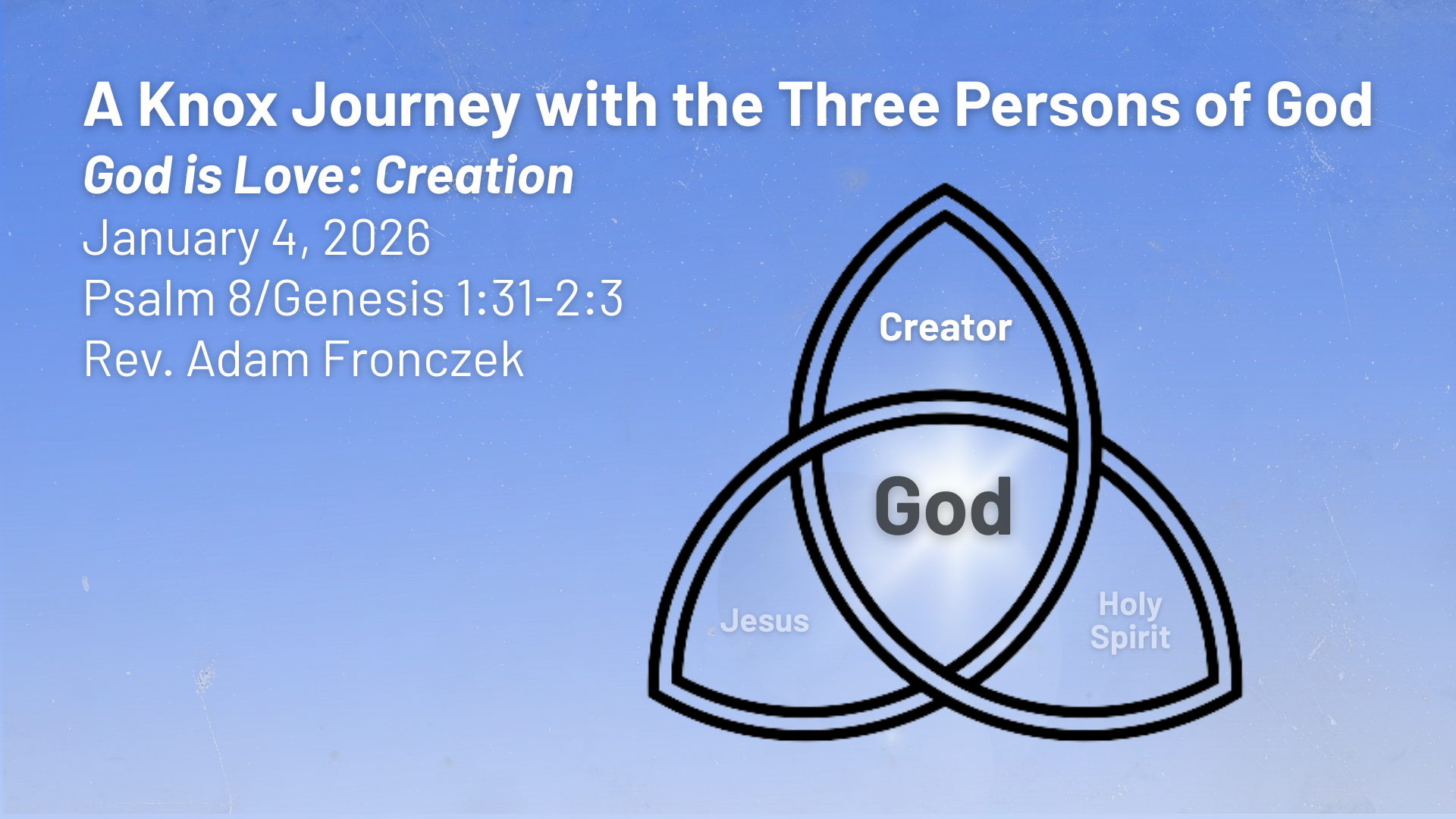
So that’s what we’re going to try to do over the winter and spring here at Knox: we’re going to talk about core beliefs about God, Jesus Christ, and the Holy Spirit—and how those beliefs shape the kind of Christians we hope to be.
If I were to sum up what Presbyterians believe, I would do it according to a rather simple formula, grounded in the Trinity—one that is not innovative at all: We believe that God created the world out of love, that Jesus Christ is with us in both our joys and in our struggles, and that the Holy Spirit is at work in the world. And everything we do: the way we worship, the kind of Christian people we are hoping to form, the inclusive nature of our community, and the way we engage in mission and service…all of that should unfold from these convictions about God, Jesus Christ, and the Holy Spirit.
So throughout the winter and spring, we’re going to go deeper in our understanding of those three persons of God. Sermons in January and February will center around God the Creator and what the earliest stories of the Bible tell us about the loving nature of God. When Lent begins, we will shift our focus to Jesus Christ: In Jesus, God came into the world in the form of a human being to be with us. What does that mean? Finally, in April and May we will consider the Holy Spirit—the ongoing presence of God in the world and in our lives—reassuring us that God is still at work in the world, and inspiring us to love one another and to be present in the lives of the least, the last, the lost, and the lonely. How does this ongoing presence of God shape our lives?
On our way, I hope to stretch your thinking about these core beliefs that have shaped Christian theology for 2000 years. But I also hope to keep these sermons straightforward enough to help you in that elevator speech about your faith. So this is a conversation. And when an idea I talk about is unclear or overly academic—when I don’t really land the plane in terms of what this means for your life, I want to hear from you. I hope you’ll push me to be clearer and more thoughtful.
That long, if necessary, introduction to the series doesn’t leave a lot of time to go deep with today’s Scripture, but maybe that’s a good test of the whole idea: Can I tell you in the next 5-10 minutes what seems most important about God in the first chapters of the Bible? Let’s find out.
In the earliest chapters of the Bible, the main idea about God is both simple and profound: God creates the world out of love and calls all of it very good; and we are invited to spend our lives in awe and wonder at the depth of God’s love. As this morning’s reading from Psalm 8 declares, “When I look at your heavens, the work of your fingers…what are human beings that you are mindful of them…yet you have made them a little lower than God.” We stand in awe of God’s Creation and in wonder when we consider God’s love for us.
Like me, many of you probably learned the earliest chapters of the Bible as isolated stories: Creation, Fall, Noah’s Ark…; but there is actually a storyline—a thread being woven from story to story that starts to give us an idea of what God is up to. Follow me through it for a few moments…
The Bible, like many other sacred texts, starts with origin stories. These are not meant to be literal historical accounts of how the world came into being—when it all started, the people who wrote the stories down were not there! These are meant to be stories about meaning: Why are we here, Where did we come from? What is it all for? That’s what’s going on in these first pages of Genesis.
So God creates the heavens and the earth and all that is in it. God does so in seven days…because that explains a rhythm for human life—a weekly cycle that gives a place for work, but also an essential role for Sabbath rest and worship and connection with our Creator. And God calls it all “very good.” In a second, similar story, a woman is created from the rib of a man because “it is not good for man to be alone.” The story shows God’s love for us in desiring that whether in marriage or family or friendship, we need one another and are not meant to be lonely.
Next is this thorny story of Adam, Eve, and the Serpent in the Garden of Eden. Every ancient civilization needed a story to explain why there is evil in the world; this is ours. Today we’re asking what this story tells us about God’s love; when it comes to that question, I think the important thing to say here is that a part of loving someone is giving them freedom. Like a heavenly parent raising children who will one day be independent: God so loves Adam and Eve that God gives them a beautiful garden in which to live…and the freedom to decide if they want to stay there. The hardest part of love can be giving a child the chance to be free; and God loves us enough to do the hard stuff.
And then there’s Noah: a good man trying to live a holy life in a broken world, and God notices. The thing I hope for you to notice about this story is that it contains what biblical scholars call an “etiology”—an origin story. “Where did this thing come from,” the ancients asked? And in the case of the Noah story, the “thing” is the rainbow. According to the story, after all the building of the Ark, and gathering of the animals, and after all the rain and flooding and destruction, there is a promise from God: “See I have set my bow in the clouds…so that you will remember my promises to care for you.” Imagine how it must have felt to live in the ancient world and try to figure out what in the world a rainbow meant or where it came from. But even in the modern world, with advanced doppler radar, the explanation is pretty simple: a rainbow appears after a good hard rain, when the sun comes out again. So the ancients decided this was a sign of God’s love, a sign of hope, a sign that even though there may be storms, God has not given up on us.
I’ve greatly simplified each of these stories; one could preach multiple sermons on any one of them. But here, in summary, is what I find to be most important in these stories: Some of us may have grown up believing that the God of the Old Testament is an angry judge interested in punishing the wicked; or you may know others who still believe that to be true. But that’s never what our tradition has taught. We believe in a loving Creator.
If I imagine myself talking to a neighbor, and the question comes up about what kind of Christian I am…I hope I might begin with something like this: “I believe in a God who created the world out of love…and called it all very good…Who, as a heavenly parent, gave Adam and Eve the freedom to choose their future, and I believe that the story of Noah is told so that every time we see a rainbow in the sky, we’ll be reminded of God’s love for us. This love that has been shown to me should shape the way I am with others. When I see around me the wars and the violence, the suffering of this broken world and the malice some people have toward others, I could easily be drawn into hopelessness or respond in hatred. But because my life is grounded in the love of God, I can choose to keep living with courage and compassion, sharing that love in whatever ways I can find.”
That’s a start. Next week I promise much less of an introduction, and we’re going to talk about Genesis 12-50. There you will find a bunch of really messed up families who teach us more about the mystery and depth of God’s love. I hope you’ll be here.
Will you pray with me? God, may we stand in awe and wonder at the world you have created in all its variety, and the love that you have for all of us…and may our life together and our life lived out in the wider world be a reflection of that great love. Amen.